karkee, a. and n. Also khakee, ka(h)ki, kharki(e, khâkee, khaki, etc.
 A. adj. a. Dust-coloured; dull brownish yellow, drab. b. (attrib. use of B.) Made of khaki cloth.
B. n. A fabric of this colour now largely employed in the British army for field-uniforms. Originally of stout twilled cotton (khaki drill), but more recently made also of wool (khaki bedford, k. serge). Also (usu. pl.), a uniform or garment made from this fabric.
- loosely adapted from the Oxford English Dictionary, second edition, 1989
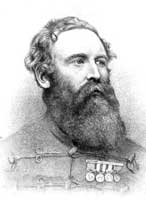
The word karkee, or khaki as it is more usually spelled these days, is derived from the Hindi word khâk, meaning dust. The invention of the khaki uniform is attributed to Lieutenant Harry Lumsden (later Lieutenant-General Sir Harry Burnett Lumsden, shown left). In India, khaki was used for uniforms by the Queen’s Own Corps of Guides under Lumsden and Hodson in 1848, and later by the troops in the Mutiny of 1857. The first "official use" of khaki uniforms, according to Byron Farwell in Armies of the Raj (1989), was in the Abyssinian campaign of 1867-68. It was worn in the Afghan campaigns of 1878-80, the Sudan Wars of 1883-98, and especially by the British troops in South Africa after 1899. Today, the word has become synonymous with military garb all around the world. We've chosen the Victorian spelling karkee for this site's title, rather than the mundane khaki, because (to us at least) it evokes the British Military at the dawn of the 20th Century: pink gin toasts to the Rani Victoria on the Deccan at sunset, portly gentlemen with moustaches that look like they've stapled ferrets to their upper lips, cheeky street urchins shouting "Mafeking is relieved!".
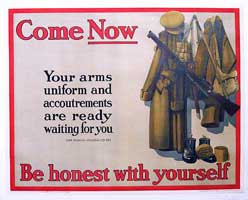 This web site is concerned not with the uniforms themselves, but with accoutrements and especially the leather and web personal equipment used by the British Military during the 20th century. We started with the very first pattern introduced for the British Army after the turn of the century, Bandolier Equipment Pattern 1903. Since then we've periodically added to our scope, moving closer to the present day as we add new patterns of equipment. Eventually, we hope to cover not only all of the patterns used by Britain, Empire, and the Commonwealth during the 20th Century, but also to include coverage of patterns that were introduced before 1st January 1901, but were still in use on that date. In addition, we also want to address selected foreign patterns. The Mills Equipment Company produced web equipment for over fifty countries, and there were other companies that produced similar equipment as well. Information on many of those is practically non-existent, and we hope that KW will, eventually, be able to help fill in that gap.
For each Equipment Pattern, the Karkee Web Team have tried to present historical information, period photos, and modern photos of original items. In all too many cases, we don't have good, original photos of the items we're trying to describe. In those cases, we've substituted the best pictures we could find, and in a few cases none at all. If a reader can supply photos of items we've missed, we would be delighted to include them. We think that this site's greatest value will be to serve as a virtual museum of British webbing and equipment. There are other web sites that address this subject to some extent, but our intention is that Karkee Web, by focusing specifically on accoutrements and personal equipment, will provide a depth of detail that is unlike any other resource currently available.
-- John Thorne (Webmaster), 30th July 2010 (revised)
It's worth noting that this is a graphics intensive site. Most (but not all) of the pictures on this site are shown in thumbnail but are linked to larger versions. Clicking on a linked thumbnail will take you to a higher resolution picture. Clicking again will return. On most browsers, the pictures that are linked to larger versions will show up with a coloured border. Linked pictures aren't otherwise designated, so if you want to see more detail, just try clicking on the picture. It might work.
This site is in a continuous state of development. New sections are planned, and will come on line as they are completed.
If you'd like to comment, add information, or point out one of my many mistakes, I can be reached by email at Webmaster. - J.T.