W.E. Patt. '08 Haversacks
Introduced with the W.E. Patt. '08 by List of Changes entry L. of C. §14288, dated 31st January 1908, the Haversack was designed to carry the soldier's those small items which he needs regularly, and which are not carried in the Pack. The Haversack underwent several changes during its service life.
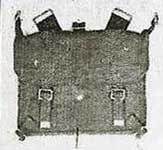 The first issue W.E. Patt. '08 was a web bag 9-inches tall by 11-inches wide by 2-inches deep. On the front, it had two 1-inch straps and two matching chapes with Twigg buckles. There were two additional 1-inch buckled chapes angles outwards at each lower corner, and in the center, below the flap, was the spigot portion of a snap fastener. There was a 2-inch Twigg buckle on either side, and on the rear, there were two 2-inch web tabs angled upwards. Between these tabs there was a single 1-inch buckled chape facing up. This chape, and the fastener spigot on the front, were used to mount the first issue Water bottle carrier when it was carried on the Haversack. Internally, there was a divider of calico cloth stitched into the rear seams to create a flat pocket. The picture shown left appeared in a broadside Fitting Instructions issued by the Mills Equipment Company in early 1908.
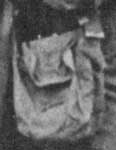
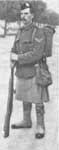 List of Changes entry L. of C. §14289,dated 27th April 1908, details the modifications of the Haversack, G.S., Mark I, for use with W.E. Patt. '08. The conversion involved cutting off the strap and using it to make the side chapes, adding the rear web tabs and chape, and adding the front spigot and bottom web chapes. The picture at left is taken from a photo of the Essex Regt, on manoeuvres, in 1910. It shows a man carrying the converted G.S.Mk. I Haversack. The photo at right is also interesting. This 1914 picture shows a corporal of the Queen's Own Cameron Highlanders, carrying a converted Haversack. If you look closely, though, the flap appears pointed, not rounded as with the Haversack, G.S., Mark I. (For comparison, see the photo of an unconverted Haversack, G.S., Mark I on the B.E. Patt. '03 Haversacks page.) This seems to support the theory that not only the Haversack, G.S., Mark I, but also other early patterns of Haversack, were converted.
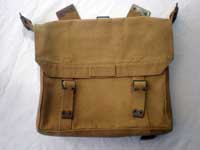
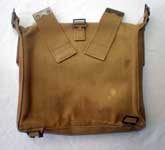
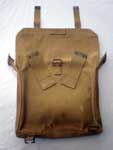 The second issue Haversack replaced the first issue W.E. Patt. '08 Haversack with List of Changes entry L. of C. §15048,dated 22nd November 1909. The L. of C. entry was a catchall of mostly minor modifications to most pieces of W.E. Patt. '08, based on the "lessons learned" in its first year of use. Changes to the Haversack included replacing the plain brass tips on the straps and tabs with eyeletted ones, relocating the 1-inch buckled chapes at the bottom front to the bottom rear (and pointing them up instead of down), and replacing the fastener spigot on the front of the Haversack with a short 1-inch web loop on its flap. There were corresponding changes to the Water bottle carrier, so that the second issue Carrier could be mounted on the second issue Haversack.
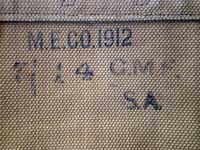
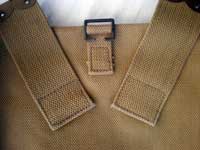
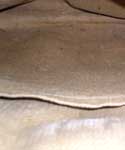 This Haversack is maker marked "M.E.CO." and dated 1912. It is also marked "7/14 C.M.F. | S.A." The image centre left shows the 1-inch buckled chape used to attach the strap on the corresponding second issue Water bottle carrier. The image near left shows the internal flat pocket of the Haversack. From the Dan Irving Collection, photos © Dan Irving 2017.
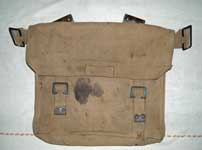
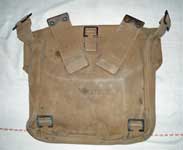
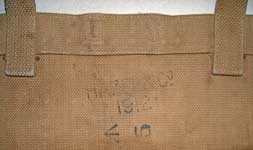 Prior to the Great War, there were only two manufacturers authorised to produce Web Equipment, Pattern 1908. These were its originator, the Mills Equipment Company (M.E. Co.), and M. Wright & Sons, Ltd. (M.W. & S. Ltd.). The Haversack shown in these photos, however, is marked "Hazel & Co."and dated 1912. This anomaly is explained by Albert Lethern in The Development of the Mills Woven Cartridge Belt 1877-1956. David Hazel was the Director of Hebbert & Co., City Road, London. They were old-time manufacturers who supplied leather equipment to the military. The introduction of W.E. Patt. '08 was, not surprisingly, a severe blow to companies like Hebbert & Co. Mr. Hazel, who had excellent connections with the Territorial Associations, approached Mills with the idea of becoming the M.E. Co. agent to handle sales to the Territorial Associations outside of London. An agreement was reached, and the association continued until Mr. Hazel dissolved Hebbert & Co. and reformed it as Hazel & Co. The ties between Mills and Hazel & Co., continued until the outbreak of War in 1914. Although Mills manufactured a number of special variations of Patt. '08 equipment for the "Terriers", this Haversack is standard Patt. '08 in every way except for the stamping.
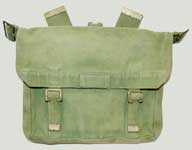 This interesting Haversack appears to conform to the second issue specifications, except that it has the early, straight crimped tips on the straps, instead of the eyeletted ones. Presumably, this is a very early example of the second issue. From the Carl Woods collection. This photo © Carl Woods 2009.
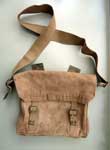
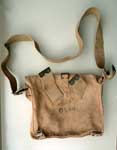 Another example of the second issue Haversack. This one is maker marked "M.E. Co." and dated 1912. From the Hans Feij Collection, photos © Hans Feij 2013.
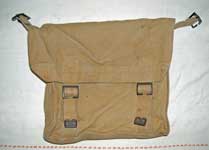
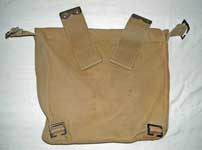 List of Changes entry no. L. of C. §16763, dated 24th February 1914 and 2nd March 1914, simplified the design of both the Haversack and the Water bottle carrier by removing the fittings that allowed the Water bottle carrier to be mounted on the Haversack. The Haversack lost its web loop on the front flap and the vertical 1-inch chape and buckle on the rear. It's not clear if this design change was made to simplify production in light of the looming clouds of war, or if the option of carrying the Water bottle carrier on the Haversack just wasn't popular enough to justify the extra cost. In any event, this is the Haversack that would be used throughout the Great War, and on to the end of the service life for Patt. '08 Web Equipment. This example is maker marked "M.E. Co." and dated 1918. From the Karkee Web Collection.
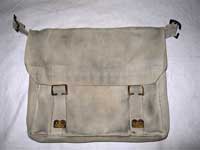
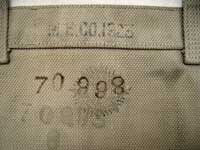 In the Mills Golden Jubilee booklet, The Development of the Mills Woven Cartridge Belt, 1877-1956, Albert Lethern states that in 1922 the Irish Free State placed an order with the Mills Equipment Company for a "large" order of Web Equipment, Pattern 1908. The equipment was supplied in a special green colour. The equipment as supplied was a complete set of Pattern 1908 Infantry Equipment, omitting the Entrenching tool head carrier and Helve holder. Also, the Frog did not have a strap for the Helve holder. KW have seen a few pieces of this equipment, including the Haversack shown here, but it has all been dyed or painted black in service. Other than the colour, this is a typical 3rd issue Patt. '08 Haversack. The markings included the usual "M.E. Co." maker's mark and a 1923 production date, but this Haversack also carries the "Fianna Fail" FF surrounded by a sunburst mark of the Irish Army. From the Sean Featherstone Collection, photos © Sean Featherstone 2010.
Haversack, Indian Pattern 1908
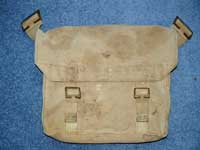
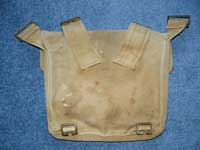 This is a very interesting example of an Indian produced Patt. '08 Haversack. The bag's front and rear faces, including the flap, are canvas, whilst the straps and chapes are web. Other than the body material, it looks to be a standard 3rd issue form.
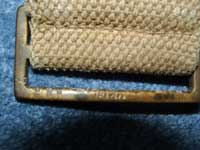
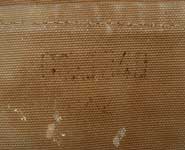 Both the Haversack itself and the brass buckles are maker marked and dated. The date reads 1940. From the Allen Prior Collection, photos © Allen Prior 2010.
The maker's mark is not really clear, but now seems most likely to be "ca". Rog Dennis has researched this and found that this mark probably indicates "Cawnpore" (not Calcutta, as previously published in other sources). Cawnpore (modern Kanpur) was a centre for the cloth and dyeing industry as far back as the mid-19th century, and is still a major Indian industrial hub today. Another possibility is "Cooper Allen", who were one of the major producers in the area, but at this point KW are proposing that the mark refers to the city, rather than to a particular manufacturer. If any of our readers can provide more definitive information, it will be very welcome.
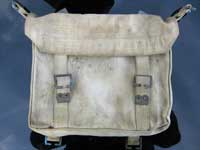
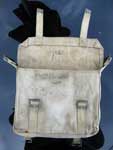
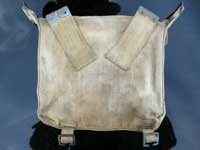 Another Indian manufactured 3rd Issue Haversack, marked as made in Cawnpore in 1942. Note the different alignments and positioning of the diagonal strap buckles in the base seam, compared to U.K. manufacture. This example also has longer buckle chapes than the 1940 Cawnpore example. From the Mark Palmer Collection, photos © Mark Palmer 2017.
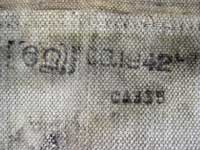
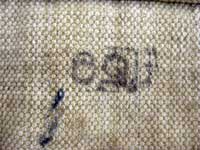 Details of the markings on the 1942 dated Cawnpore Haversack. Unlike the 1940 dated example above, the body of this Haversack is made entirely of webbing, rather than part canvas.
Haversack, Mills Web Equipment for Infantry Regiments (New Zealand "Pattern 1911")
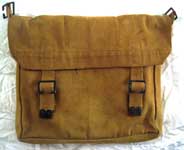
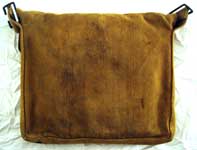
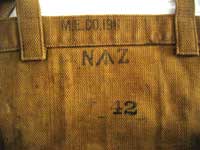 The Mills Web Equipment for Infantry Regiments was introduced by the Appendix to the Journal of the House of Representatives, Section H19, Annual Report of the General Officers commanding New Zealand Military Forces for the period ending 27 July 1911. This variation of W.E. Patt. '08 is often referred to unofficially as "Pattern 1911".
This version of Patt. '08 is quite interesting and will soon (we hope) be the subject of its own separate section of Karkee Web. Meanwhile, many of the components of this pattern will be addressed in the appropriate Patt. '08 pages.
The Haversack is unique to "Patt. '11". It is identical to the Patt. '08 3rd issue, but lacks the 2-inch angled rear tabs and 1-inch bottom buckled chapes. Without these fittings, it can only be carried suspended from the brace ends. As with all items of this pattern, the web is a slightly different colour than "standard" Patt. '08, and the brass fittings are blackened. This example is maker marked "M.E. Co." and dated 1911, and is also acceptance marked "N [broad arrow] Z". It is from the Barry O'Sullivan Collection, photographs © Barry O'Sullivan 2012.
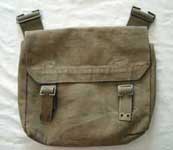
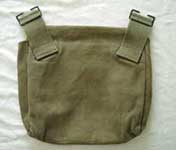 The "Other Services" Haversack entered into service under List of Changes entry L. of C. From the Karkee Web Collection §15459, dated 20th February 1911. The entry states that this Haversack is "for units not wearing 1908 web equipment", and that it is intended to replace the Drab, N.P.D.S.. M.S. and G.S. haversacks. The O.S. haversack uses a Patt. '08 Brace as a sling. It is similarly made to Patt. '08 Web Equipment, but it is smaller than a Patt. '08 haversack. In size and shape it very closely matches the G.S. haversack, and was used with Bandolier Equipment, Pattern 1903, during the Great War. This type of Haversack often mistakenly referred to by collectors as the Pattern 1908 "mounted" haversack. This is incorrect in that this Haversack is not part of the Pattern 1908 Web Equipment, but its List of Changes entry does indicate that it was intended for mounted service, stating in part "all tabs, buckles, &c., not required for mounted troops have been removed." This example is maker marked "M.E. Co." and dated 1915. From the Karkee Web Collection.
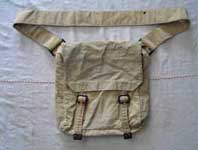
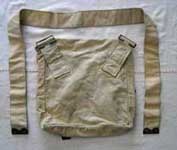
This is an Australian version of the Other Services haversack, made in yellow canvas and complete with a matching canvas strap. This Haversack is not make marked or dated. From the Karkee Web Collection.
Haversack, other services, converted
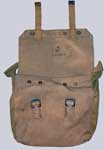
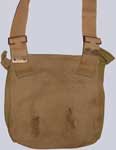
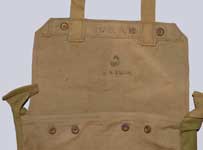
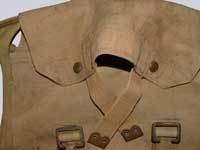 This interesting Haversack, other services, has been converted for use as a gas mask bag. The conversion was simple, and consisted of adding two crown fasteners to the flap and four corresponding fastener spigots to the body. As can be seen from the photos, when the mask was not in use the fastener crowns were fixed to the two outer spigots. In service the crowns were moved to the inner spigots, which created a covered opening for the hose to exit the bag. This Haversack was originally produced by Hepburn, Gale, and Ross in 1916. It is '16 dated and "H.G.R." marked. The conversion markings are "Maple & Co." with a date of 1918. From the Grant Napier Collection, photos © Grant Napier 2009.
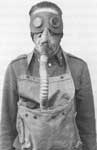 Karkee Web has just received an interesting comment about this conversion. Allen Prior suggests that the conversion is actually the other way about - he thinks that this is a Haversack for the short-lived Large Box Respirator, which has been converted into a Haversack, other services! Shown left is the Large Box Respirator and its Haversack, in a photo taken from Chemical and Biological Defence at Porton Down 1916-2000 published by TSO (The Stationary Office) in 2000. As Allen puts it, "There are machine darns on the reverse where the securing strap would have been; the straps are a different shade of khaki and the press studs are very indicative of the haversack for the large box respirator." He may well be right, looking at the photos. It looks like it's back to you, Grant. You've got the piece in hand - does it appear to you to be a conversion from an LBR Haversack? Comments from anyone else?