Simon is a French accoutrements collector, and the moderator of a French Great War Forum, histoirémilitaria14-18. Many of the photos shown here were originally published on that forum, and are used here with his permission.
Shown below are a few very interesting and unusual items from his collection. We had previously requested more information on this pattern, ands Simon himself has been able to provide it. Below, Rog Dennis has written a short article describing the newly discovered information. All photographs on this page are © Simon Braillon 2010.
Karkee Web are indebted to Simon Braillon for the photo at left. This has to be the shortest interval between actual items and a contemporary photograph emerging, thoughtfully captioned by the unit involved, the 43e Régiment d'Infanterie, on the 8th November 1914. La Courtine is a small village in the Creuse Département, of the Limousin Region of Central France. In 1904, a military camp had been established there, capable of housing 4,000 soldiers. The photo is important, not just for proof that a second webbing pattern was used by the French Army, but for the details that can be observed and speculated on. Simon has personally tagged it as Deuxieme Modèle Mills, the unsuccessful Mills-Bruzon Equipment set being La Premiere Modele Mills. Production is reported to have been to meet the emergency of late 1914, so it would not be un-reasonable to steal the U.K. “emergency” pattern’s identity and refer to it as Modèle 1914 Mills Equipment de sangle!
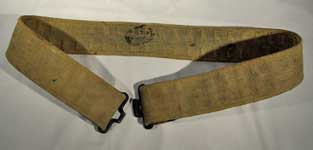
In 2005, Martin Brayley’s book BAYONETS: AN ILLUSTRATED HISTORY contained a photo of a poilu dressed in an horizon-bleu greatcoat, over which was a 2.25-inch wide Waist belt, in flat-loop belting, with the U.S. style loop and olivet buckle. Typically, French Bayonet frogs had double belt loops, here reproduced in webbing and fitted with a webbing strap and buckle, which secured through the horizontal scabbard loop of M-1886 “Rosalie” bayonet, in the usual French manner. At the time, we had no idea what pattern this could be, or whether what the photo showed was the whole pattern, i.e. just a Belt and Frog for a Drill Order, or Walking Out. Now, with the benefit of Simon’s photos, a little more can be adduced, not the least of which being that it was in blue-grey webbing. There is a second design of Frog, of Patt. ’25 proportions and pointlessly fitted with a press-stud, as with Patt. ’25, but with a solid scabbard loop. The scabbard staple sits on top of this web loop, the ½-inch strap passing from inside the frog, through the metal staple and down to the frog buckle.
The Belt is supported by reduction woven Braces, which attach to the Ammunition pouches in front. French practice with Mle.1893 leather equipment was a “Y” brace form and this was reproduced in webbing, with the junction point of the three straps being to a brass ring. A second form of Braces has brass eyelets set into all three straps, in which the standard twisted hook is inserted, for attachment to the twisted wire loops on leather Cartridge pouches. It is felt that this is a later addition, in order to create interchangeability between web and older leather Pouches.
The Pouches have sides and bases formed from 2-inch wide web strapping, possibly extended into weather flaps. The front may be a separate section of webbing, but could be in one piece with the back and flap. The flap closes with a ¾-inch strap and buckle. The reverse has a long patch of 2-inch webbing, which secures a pair of “C” clips set near the edges of the pouch. On Simon’s example, the Brace attachment buckle has been removed, but the remaining cut edges show that an inverted “V” of 1-inch webbing was stitched in behind the patch. A 3-bar buckle was secured to this “V”, by being pinched into the fold and stitched. Internally, a second layer of thin webbing is visible, stitched to the inside of the rear face. This may extend all round the interior, as extra waterproofing. It is un-divided, which suggests packeted ammunition, not the 3 round clips of the later Berthier Rifle, the soldiers here having Lebel rifles, which had a tubular magazine.
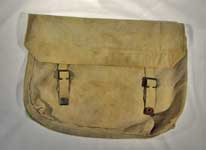
The “V” attachment allows the Brace ends to hang below the belt, though there are only three ends. A front end, plus the rear carry the Haversack, which has wide-set and angled buckles and chapes to suit. This places it more over the left buttock usually, which was its typical position, not at the side. This means only one spare Brace end is available, so it seems unlikely there was a framework Carrier for the distinctive Water bottle, with its filling & drinking spouts. Black straps are visible, on which the bottle was carried, this being borrowed from the existing leather equipment. In this group, the old standard canvas Haversacks (musettes), in two colours, are being carried on slings. The crossed Bottle and Haversack slings fly in the face of Mills’ practice, which was to free the chest of compressing straps.
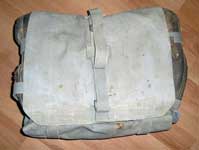
The Rucksack is supported on reduction woven straps, like the Braces, the narrow ends attaching to a pair of metal loops, set close together on the rear face. The straps are absent on this example, so they may have been stitched round the loops, or be removable. A full depth flap is secured by two 1-inch straps, which secure to buckles above the lower edge of the reverse face – where they would no doubt dig into the wearer’s back, augmented by a third buckle for the long, vertical load strap that typefies the leather M-1893 Rucksack. The location of these buckles is another point against Mills practice. Thoughtfully, fixed loops are positioned above the flap strap buckles, to tidy away the running ends.
Each side of the Rucksack has a pair of blanket straps – but no buckles are visible, nor are they in the photograph. They cannot be closed loops, as the boots could not be inserted easily. This suggests they are long straps, stitched into the rear wall seam and long enough to encompass boots and a horseshoe roll of the greatcoat / shelter tent / blanket and to buckle up under the flap. (See Patt. ’25 Upper Rucksack for comparison. ADD LINK), Two strap loops are positioned on the flap, one centrally, the other above the front fold of the flap. The load strap has been tidily stored, so its form is difficult to make out, but a 3-bar buckle is visible in the lower fold. One end is stitched in the gap between the shoulder strap attachments. It will be long enough to cope with the rolled greatcoat and Individual Mess Tin (there were other communal forms, shared out between groups) on top and possibly more. The French Rucksack was routinely loaded to an incredible height on top, with folded and layered items under the greatcoat. The M-1893 Rucksack was typical of such box knapsacks in having laterally buckled flaps under the full-depth main flap. The internal arrangement, under the flap of the web Rucksack, is not yet known.
The leather M1893 Rucksack had two piece shoulder straps, a broad shoulder flare and a narrower, underarm counter strap loosely rivetted to the broad strap. It is not clear how this was replicated in the webbing form, but the rear man, second from right, has some kind of metal fitting in his armpit. This might be a component noted in other Mills’ Rucksacks, which is a narrow (top-to-bottom) strap with an eye, or side loop. In such an arrangement, the counter strap is stitched to the eye, with a buckle adjusted loop at its further end, either carrying a hook to attach to a base ring, or attached directly to a base dee and adjustable through it. The M-1893 Rucksack straps buckled to the base, which is probably the arrangement here. The missing shoulder straps and un-availability of photos showing the base, makes it impossible to determine what arrangement exists. On the rear view, a web chape is visible at the bottom left-hand corner. The corresponding chape opposite has been cut off. Whatever fitting – loop, or buckle - has been removed.
There are ink-stamps, of typical French form, but no markings for ME Co, or the bullet trademark of M.W.C.B. Co. It is therefore thought that this pattern was made up in France, using stocks of material delivered from the U.S.A., unless it can be shown that the French company, Le Coton Filé, had the capability for both reduction weaving and integral weaving. A faint larger stencil, on some items, appear to say “R.F.”, for Republique Francaise.
Simon has established that this Pattern was intended for training units, with no evidence of it reaching front-line troops, but the possibility that French Territorial units may have taken into field service. Apparently, all the French “Mills” items were issued to the 1er Corps d'Armée, comprising eight regiments belonging to northern France:- 8e RI de St. Omer; 33e RI d'Arras; 43e Régiment d'infanteire de Lille; 73e RI de Béthune; 84e RI d'Avesnes; 110e RI de Dunkerque; 127e RI de Valenciennes and also the Territorial régiment that was attached to this 7 Régiments d’Infanterie (R.I.).
Rog Dennis, July 2010
KWRT member, Ed Storey, has also furnished details from his French contacts, which set this unexpected Model into a context:-
The Mills-Bruzon Equipment was tested by the French in 1908 and 1912, but none were ordered. Mills opened a subsidiary company in Paris, in 1914 (Le Coton Filé) but it only received very small orders during the emergency of late 1914. Another Mills branch, Socitiété Anonyme Française pour l'Equipement National (SAFEN), opened in April 1918, with not much more success and closed down in 1920. Apparently the French Army did not see any advantage in webbing, did not want to pay royalties and the leather industry had to be protected. Furthermore, France did not produce cotton, which would have been a major problem.
Ed Storey, July 2010
Modèle 1914 Mills Equipment de sangle


Waist belt. It is 2 1/4-inches wide, made from Mills style flat loop belting, with a US military style loop-and-olivet buckle. There are no rear buckles.
Belt details, showing the US Mills style buckle, which was also used by M.E. Co. prior to 1919.


Haversack. Typical Mills construction overall, with 1-inch angled rear chapes with open bar Twigg buckles, no side chapes.
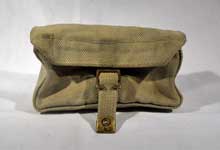
Rear view of Pouch, and a detail of the stamp on the interior. In the rear view, notice that a part of the brace attachment fitting has been cut off.